
Food Insecurity in Humboldt
by Maranda Vargas
It is a warm sunny September day in the coastal community of Eureka. The sun’s rays are shining on the constant flow of cars entering the north parking lot of Bayshore Mall. Several rows of bright orange traffic cones are lined up forming lanes in a well-orchestrated attempt to direct the incoming traffic. Volunteers wearing bright yellow vests interact with the vehicles, guiding the cars into several lanes.
Winding around the parking lot, the two long serpentine lines lead towards a couple of tables stacked with prepared bags of food. As cars approach the two stop signs next to the tables, volunteers rapidly load the prepared bags into the vehicle.
The California Association of Food Banks estimates that 20% of people in Humboldt County reported not having enough to eat. Food for People is a food bank that serves Humboldt County, providing food assistance county-wide to those who are experiencing food insecurity. Food for People offers a myriad of programs and services, including the community food distribution event taking place at the Bayshore Mall parking lot in Eureka.
A car enters the parking lot from the opposite direction and Food for People volunteer Scott Thompson rushes to assist the driver, directing the Peru driving the vehicle towards the back of the line. Thompson serves on the board of directors of the organization and has been part of the senior homebound program for over three years; but this is his first time working at an event.
“It’s shocking, not in a good way. It’s also really impressive how efficient they are getting people what they need,” said Thompson. “There were already people waiting here at nine and that just shows the amount of need and that there is the fear that people have that there’s not going to be enough.”
Carly Robbins, director for the nonprofit, mentions that at the food distribution event in August, they had nearly run out of food. “Typically, during one of these, you’ll see about four to six hundred households, last month we saw as high as seven,” said Robbins. “It’s hard to plan but we try to make sure we have enough food on hand.”
With an increasing need for the services Food for People provides Robbins is concerned about the organization’s ability in the future to provide the services the community requires. “We rely on food donations. We also do a lot of our own food purchasing, and food prices are going up for us just like everyone else,” said Robbins. “So there’s definitely the concern of can we keep up our resources with the demand. We are really trying to map out what that looks like.”
“Erin, who runs our choice pantry, probably saw the biggest impact last month in just our Eureka. So one of our pantries we served, I think 1600 individuals in a month and that’s the history of food for people. Yeah. You know, typically 1000 is probably like a high month for us during the holidays. And we’re meeting that every month.”
One in five Californians are experiencing food insecurity. Meaning they do not have enough funds to cover living expenses and purchase food for themselves and their families. In March 2020, as a response to the COVID-19 pandemic, Congress provided temporary flexibilities for CalFresh to help individuals and families mitigate food insecurity while stimulating the economy. According to the Food Research and Action Center, the emergency allotment lifted 11.5 million people out of food insecurity in 2021. Even when the emergency allotments were in effect during 2022, the U.S census data shows that child poverty had doubled.
The Consolidated Appropriations Act, passed in February, ended the funding of emergency allotments. The Consolidated Appropriations Act, passed in February, ended the funding of emergency allotments. As of March 2023, the state of California had stopped its emergency allotment program, with significant cutbacks to those who receive CalFresh and Snap benefits such as older adults who only qualify for the minimum SNAP benefit. The recipients felt the impact of those cutbacks in April when many saw their benefits decrease from $281 to $23 a month.
The cost of food, gasoline and utilities has increased, while most residents have not seen an increase in income. Members in the community are experiencing financial hardships and difficulty making ends meet. There has been an increase in community members utilizing the resources that pantries like Food for People and OhSNAP provide.
The produce distribution event on September 28 utilized about 45 volunteers to serve the community members that drove out to the event. Just a couple days before the event, Robbins sent out an email saying they still needed a few volunteers to help distribute food. Xuyen Nguyen with Coast Central Credit Union saw the post and quickly went into action to plan for a team of five volunteers from their workplace to assist. The volunteers were all smiles at the event, rushing into action as each car was called forward. Someone would approach and ask how many people were in the household, then they would call out the number of produce bags needed. The team of volunteers, several dressed in business attire, rapidly rushed back and forth carrying bags and placing them in the patron’s car with precision. Cathryn Noel-Veatch who does marketing for the bank, grew up in Eureka and enjoys volunteering and assisting the community.
“It’s really nice to just be able to give back and be able to help out where I can”, said Noel-Veatch. “It’s always so great to help them out. They’re a really great organization.”
The Food for People Eureka Choice Pantry estimates pantry visits increased by 60% in August setting a record for the highest visits to the pantry. The Choice Pantry operates as a grocery store for income-eligible individuals to access healthy and nutritious foods. The Choice Pantry coordinator Erin Tharp, who has worked for the nonprofit for nine years, says the hardest part is not being able to meet everyone’s needs. The food is supposed to be supplemental and sometimes an individual’s needs are greater than the pantry can meet.
“We’re seeing more new clients than we’ve ever seen before,” said Tharp. “The costs of everything are rising, all these programs have ended, and it puts people in a position where they can’t meet all their needs.”
For community members living in rural areas, accessing fresh food and resources can be difficult. Food for People has mobile produce pantries that travel to both local and rural communities. The program is intended to bring an extra amount of produce in addition to the pantry services; however, since the pandemic, they have been adding a larger variety of food, including non-perishable items to the delivery boxes.
Heidi McHugh of Food for People has seen a steady increase in requests for Food for Peoples services since the ending of the emergency allotments and expressed concern for the local economy. Nearly three million Californian households lost the extra food benefit. The emergency allotments had previously provided an additional $67 million into the state’s economy, reducing hunger, and helping families living on low wages.
“That hits the retailers and the grocery stores. It hits the workers since they themselves are SNAP recipients and are hungry now,” said McHugh. “It has a ripple effect through our communities and our workspaces.”
College students have been one of the groups impacted by the loss of SNAP benefits. During the pandemic The Department of Agriculture relaxed SNAP eligibility requirements for college students, allowing for those who are considered single household adults to qualify for financial aid, regardless of hours worked. A 2020 study review found an overall weighted average of 41% of students experiencing food insecurity. Researchers estimate as many as 3 million college students were added to the program as a result.
Tori Norgard, a Cal Poly Humboldt psychology major saw their EBT benefits significantly cut in April because of the ending of the emergency allotments. Norgard, whose benefit was decreased by $150 a month after the end of the emergency allotments, just recently learned of the resources available on campus through OHSNAP.
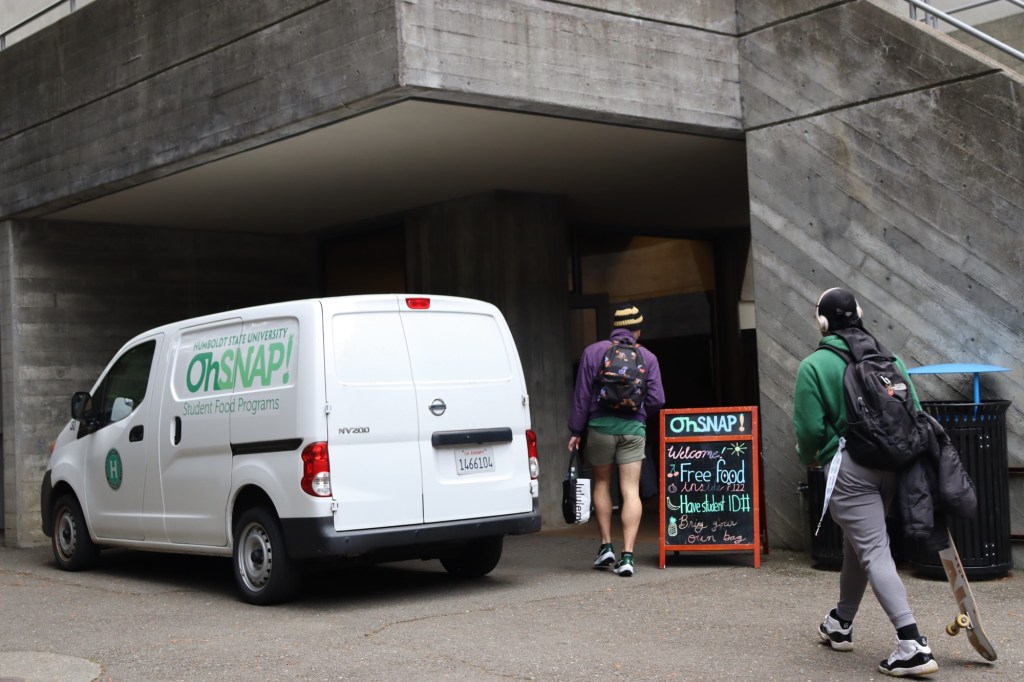
“I really appreciated it more,” said Norgren. “And I try and tell everyone about it because it’s really important and you can get free food like it’s free food and it’s free healthy food.”
The OhSNAP pantry located on the campus of Cal Poly Humboldt has experienced an influx of student visits. The OhSNAP! pantry is a valuable resource for Humboldt students who are struggling to afford food. The pantry helps students to meet their basic needs and to focus on their academic success.
“And it’s really nice because I’m on ebt and even though I have EBT it’s nice just to have another source of food you can get on campus, ” said Norgren. “It’s free because you know, got to take what you can get with everything being so expensive.”
Cal Poly Humboldt students can visit the pantry once a week to receive a free bag of food items and twice daily for snacks. The pantry offers a variety of food items for the students to shop for including fresh fruits and vegetables, dairy products, as well as a weekly fresh produce stand during the Fall Semester. The fresh produce is purchased from Earthly Edibles, a local farm during the growing season. OhSNAP also offers CalFresh application assistance, outreach events, recipe cards and connections to other local food resources.
“And there’s like a ton of like resources inside the little room because you can have like hey, we have this like big, you know, like a big bulletin board of all the fun stuff that’s in there too,” said Norgren. “And it’s just a huge little hub for students to go to.”
OhSNAP coordinator Ani Glenn reports that since reopening in August for the fall Semester, the pantry has seen an average of 650 students a week, a slight increase from previous years. In previous years the on-campus pantry had served 600 students a week during their busiest times.
“That’s something that we’re really hearing about from our folks who are coming in is that they don’t have money for groceries,” said Glenn. “It’s gotten super expensive, and so they’re often coming to us for their only produce that week.”
Glenn has needed to purchase more food than usual for the pantry to keep up with the demand; however, not all the funding has come through this semester for the program. Glenn has said that since they are having to purchase more food, they are spending the funding a lot quicker than they should be.
“Ultimately, my biggest concern is for the students who are relying on us as their main source of food. Food Insecurity is a really large issue not only on this campus, but in this community,” said Glenn. “I think it’s super important that we put that effort towards staying open and making sure we have accessible hours for folks to come in.”
Cal Poly Humboldt students not only shop at the OhSNAP pantry on campus but can also hang out and enjoy a coffee or tea while feeling a sense of community. The pantry has coffee, tea and snacks along with a variety of personal care items available to students on the days they are open.
Beyond increasing access to food, organizations like OhSNAP and Food for People are striving to destigmatize food insecurity. The pantries are often set up to give the customer purchasing power to shop for themselves from a selection of groceries.
The North Coast Growers Association is part of the California market match consortium which is a statewide consortium of over 300 farmers markets throughout the state. The Market Match program doubles the purchasing dollar of CalFresh funds up to $10 towards the purchase of fresh produce at the farmers market CalFresh dollars. The program benefits customers as well as local farmers and vendors at the farmers market, boosting the local economy.
Laura Hughes, director of operations with the NCGA reports a decline in spending and attendance by those with EBT at the farmers market since the ending of the emergency allotments. The decline in market match participants following the decrease in SNAP benefits left a temporary surplus in the Market Match budget, since the funds had been allocated prior to the ending of the allotments. Prior to the ending of the emergency allotments the farmers market was seeing a higher level of EBT dollars distributed at the market. Hughes is concerned that programs like Market Match are at risk of losing more funding in the future. Food insecurity is affecting many in our community and the loss of money spent at the farmers’ market transfers to the farmers and the local economy.
“We’re all very scared to see what budget reconciliation is going to happen on a federal level because of the debt limit and the negotiations that two parties are trying to make about spending reductions, ” said Hugh. “And we know that benefits programs like SNAP are going to be some of the first things that are on the cutting room floor. So that’s something that’s a huge concern to us. We can’t afford yet another decrease in benefits on top of what’s already happened after the pandemic.”
Importance of Volunteers
Without the support of community donors and volunteers, food banks such as Food for People wouldn’t be able to serve the community effectively. Julie Ryan, Volunteer & Direct Services Manager for Food for People knows the importance and value that volunteers bring to the organization.
Food for People’s volunteer manager Julie Ryan relies on volunteers to meet the crucial need of servicing the community. Food for People has mobile food pantries, satellite pantries, senior programs, backpacks for kids, birthday bags for kids, children’s summer programs, drive thru distribution events, food drives, nutrition education as well as emergency and disaster program.
“Food for People cannot do what it does without volunteers. Volunteers are 30% of our people power and last year, put in over 15,000 hours of work,” said Ryan. “It’s a lot of really dedicated community minded people who see hunger as a crucial issue.”
It is the people that volunteer for the organization as well as those they serve that most delight Ryan. Stories of friendships formed and a purposeful mission fuels those who grind behind the scenes to keep the organization propelling forward. The organization is always in need of more volunteers and donations. Once a week there is an online orientation for those interested in volunteering.
“Our community is incredibly generous. A lot of that generosity often comes from people who are just regular folks. As my grandma would say, it’s just down home folks who like to help,” said Ryan. “It’s just a wonderful connection that we have in the community. It feels like okay, we can’t solve all the world’s problems, but we can resolve things in this bubble.”
Hungry for Change was previously published in Osprey Magazine Fall 2023
 Featuring Humboldt